SkipHireCost.com is an independent price guide. We do not sell or arrange skip hire. Prices are indicative estimates based on market research.

What Can and Can't Go in a Skip? The Complete UK Guide

For every banned item: what it is, why it's banned, and where to dispose of it instead. Plus the grey area items that some companies accept and some refuse.
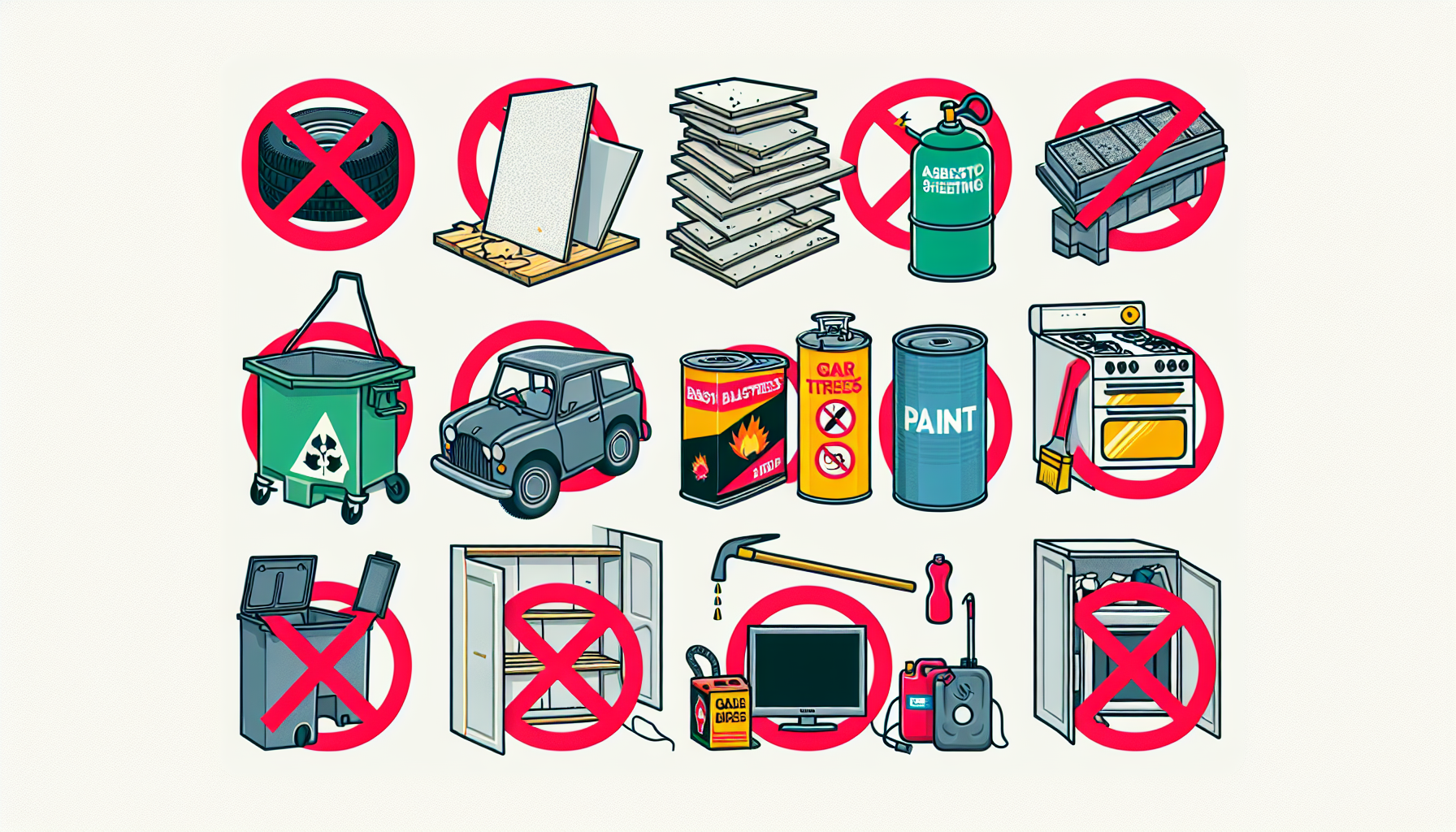
Infographic showing items banned from UK skips including asbestos, tyres, batteries, gas canisters, paint, fridges and electrical items

Items You Cannot Put in a UK Skip

X
Asbestos
Why banned: Carcinogenic fibres - Asbestos Regulations 2012
Where to dispose: Licensed asbestos removal contractor only. Costs £300-2000+ depending on quantity and type (bonded vs loose). Do not disturb or handle without specialist PPE.
X
Plasterboard / Gypsum
Why banned: Produces toxic hydrogen sulphide gas when mixed with organic waste in landfill (landfill directive 2003/33/EC)
Where to dispose: Dedicated plasterboard-only skip (£100-180) or household waste recycling centre plasterboard bay. Some councils have free plasterboard disposal.
X
Tyres
Why banned: Classified as hazardous waste - Waste Management (England and Wales) Regulations 2006
Where to dispose: Tyre retailers (free when buying replacements), specialist tyre recyclers (£2-5 per tyre), or household waste recycling centre tyre bay.
X
Batteries (all types)
Why banned: Contain hazardous chemicals (lead acid, lithium, cadmium)
Where to dispose: Supermarkets and electrical retailers have free battery collection points. Councils must provide battery recycling at HWRC.
X
Gas Canisters / Cylinders
Why banned: Explosion risk during skip handling and at waste processing facilities
Where to dispose: Return to supplier (most gas suppliers take back cylinders). Smaller camping gas canisters: specialist recyclers or hazardous waste events.
X
Paint, Solvents, Oils
Why banned: Classified as hazardous liquid waste - Environmental Protection Act 1990
Where to dispose: Community recycling events, household hazardous waste collections (some councils offer free). Dry paint tins (lid off, fully dried) can sometimes go in general waste.
X
Fridges and Freezers
Why banned: Contain refrigerant gases (HFCs, HCFCs) that must be professionally extracted - F-Gas Regulation
Where to dispose: Council bulky waste collection, retailer take-back (often free when buying replacement), household waste recycling centre (they have specialist handling).
X
Electrical Items (WEEE)
Why banned: WEEE Directive 2012/19/EU - TVs, computers, white goods with motors, anything with a plug or battery
Where to dispose: Household waste recycling centre WEEE bay, retailer take-back (required for like-for-like purchases), registered WEEE recyclers.
X
Clinical / Medical Waste
Why banned: Biological hazard - Controlled Waste Regulations 2012
Where to dispose: NHS or local authority clinical waste collection. Sharps bins from pharmacies. Never mix with household waste.
X
Firearms / Ammunition
Why banned: Legal restrictions and safety hazards
Where to dispose: Contact local police for surrender. Licensed firearms dealers for deactivation.

Grey Area Items: Check With Your Company First

Mattresses
Some accept with surcharge

£20-40 extra per mattress. Ask your skip company before booking. Many refuse them entirely.

Plasterboard (small amounts)
Most refuse

Even small amounts require separate disposal. Check if your company has a dedicated plasterboard skip.

Soil and turf
Usually accepted within weight limits

Soil is heavy - weight limits apply. Soil-only skips may be priced differently. Always mention soil volumes when booking.

Food waste
Some accept, some don't

Bagged food waste is sometimes accepted in small amounts. Commercial food waste is not. Check with your company.

Treated or painted wood
Usually accepted

Treated timber can go in most mixed waste skips. Only untreated wood goes in 'clean timber' specialist skips.

What CAN Go in a Standard Skip

+General household waste
+Timber and wood (untreated)
+Bricks, tiles, and masonry (within weight limits)
+Concrete and rubble (within weight limits)
+Garden waste (grass, branches, plants)
+Metal items
+Plastic
+Cardboard and paper
+Carpet and underlay
+Furniture (excluding fridges/WEEE)
+Clothing and textiles
+Glass (bottles, windows)

Your Duty of Care as Waste Producer

Under the Environmental Protection Act 1990, you have a legal duty of care as the producer of waste. This means you must ensure your waste is handled by a licensed waste carrier. Always check that your skip hire company is registered with the Environment Agency (check at gov.uk/guidance/check-if-a-waste-carrier-broker-or-dealer-is-registered). If they aren't registered, you could be held responsible for illegal disposal of your waste.

Frequently Asked Questions

Can you put plasterboard in a skip?

Not in a standard mixed waste skip. Since 2009, regulations require plasterboard to be disposed of separately because it produces toxic hydrogen sulphide gas when mixed with organic waste in landfill. Some skip companies offer dedicated plasterboard-only skips at around £100-180. Alternatively, take plasterboard to a household waste recycling centre or arrange specialist collection. Never mix plasterboard with general waste.

Can you put a mattress in a skip?

Some skip hire companies accept mattresses with an additional surcharge of £20-40 per mattress. Many refuse them entirely because mattresses are bulky, awkward to process, and have specific recycling requirements. Always check with your skip company before putting a mattress in. Alternatives include council bulky waste collection (£25-40 for 3-5 items), charity collection if in good condition, or specialist mattress disposal services.

What happens if banned items are found in a skip?

If banned items are discovered at the processing facility, you will typically receive a surcharge invoice - these can be substantial, sometimes £100-500 depending on the item. For asbestos or other seriously hazardous waste, the skip may be quarantined pending specialist disposal at your cost. In the worst case, you could face prosecution under the Environmental Protection Act 1990 as the waste producer. Always declare special waste before booking.

Can you put electrical items in a skip?

Electrical items covered by WEEE regulations (Waste Electrical and Electronic Equipment) cannot go in a standard skip. This includes TVs, monitors, computers, white goods with electrical components, and any appliance with a plug or battery. Take them to a household waste recycling centre, arrange a council bulky collection, or use a dedicated WEEE recycler. Some skip companies make exceptions for pure metal items like electric motors.

Garden waste guideBuilders waste guideSkip alternativesCost calculator